DoubleTree by Hilton Naha breakfast buffet, and the ¥5,810 senbero night that followed
This article contains affiliate links to hotel booking sites; if you book through one we may earn a small commission at no cost to you. How that works.
Check rates for DoubleTree by Hilton Naha: Expedia · Klook · Official site
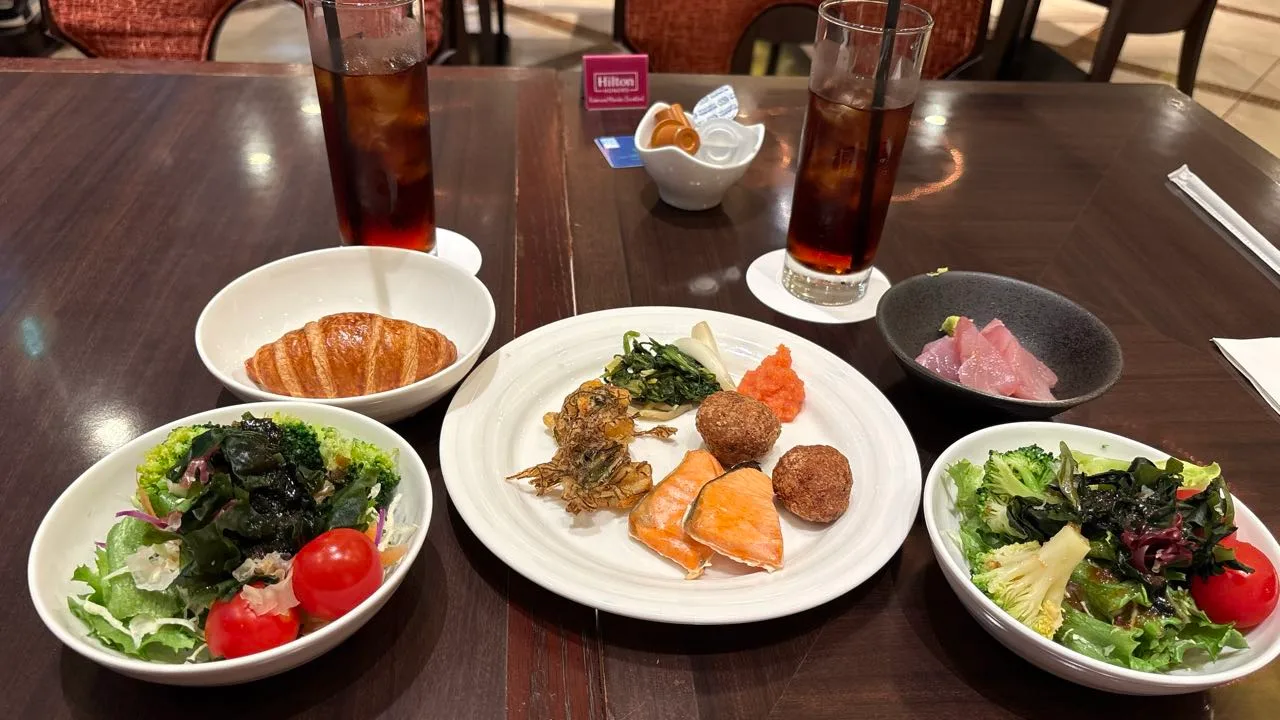
DoubleTree by Hilton Naha has no executive lounge, so our days there have two fixed points: the breakfast buffet, and an evening drink somewhere within walking distance. The breakfast is the meal we look forward to every time, and as one of us sees it, eating here makes a trip to an Okinawan restaurant unnecessary. This was Tuesday 20 October 2026, the second day of our stay, and we were back after half a year.
We were shown to a table and asked whether we would like the usual to drink. One of us needed a second to remember what that was. The server did not: “Two iced teas, as usual?” Yes, please. Whatever this hotel does with its handover notes, it works.
The Okinawan counter
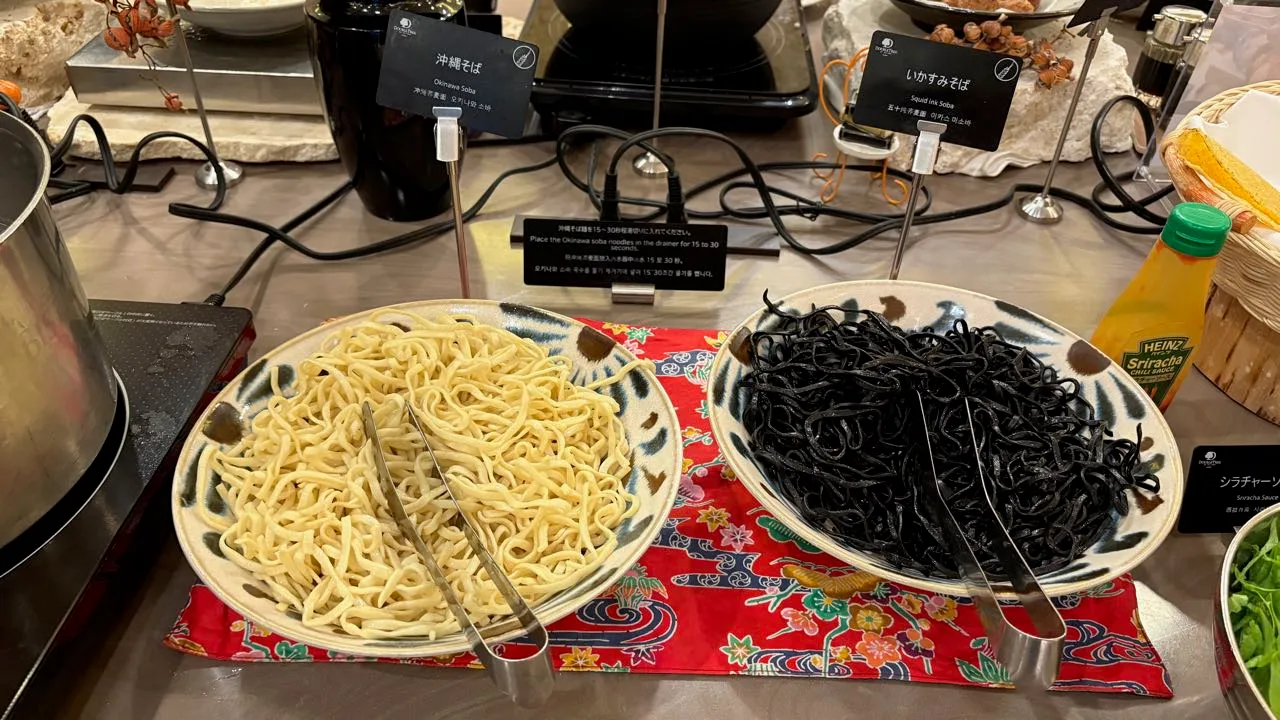
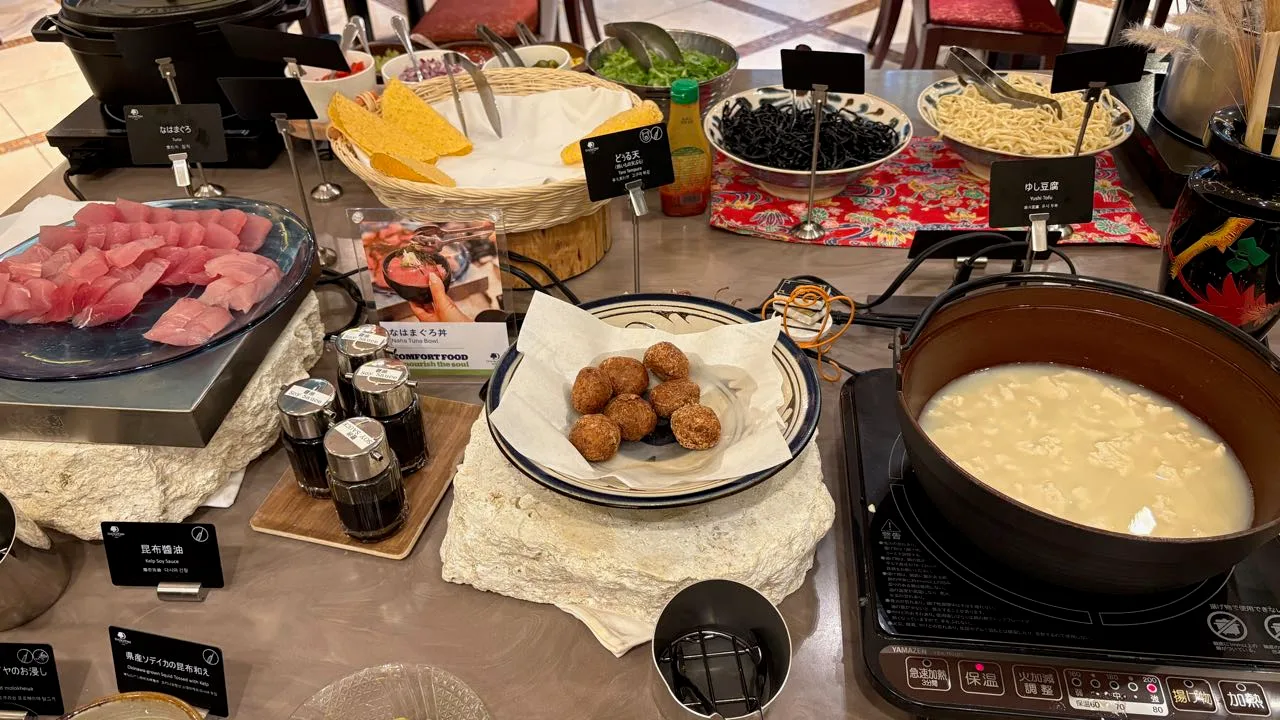
Okinawa soba is still there, with plain or squid-ink noodles, and the toppings now include aasa (a green sea laver) and chikiagi, something like kamaboko fish cake. Then Naha maguro, the local tuna; local sode-ika squid dressed with kelp; dooru-ten, which the card calls Taro Tempura; yushi-dofu, soft tofu; jimami-dofu, peanut tofu; goya champuru; and a fritter of Ryukyu chives and local mozuku seaweed. The Okinawan dishes were all good.
The dooru-ten we would take again. One of us bit in and found it good, well seasoned and chewy; “This is good,” said my wife. A certain repeat.
My wife is not keen on the bitterness of goya and still called the goya champuru delicious, which says something about the seasoning. It had pork in it, and the agebitashi of Okinawan vegetables (fried vegetables soaked in broth, new to us) had chicken, with shiso as an accent. “There’s meat in everything,” said one of us. “Isn’t there? Impressive,” said my wife.
The rest of the buffet, and what changed in half a year
Most of it was as we left it, though the range seemed to have grown. The black vinegar and onion dressing stays; the other two are now tom yum and truffle. Among the small bowls of things for rice was karashi mentaiko (spicy cod roe) from Okinawa Yamaya (沖縄やまや), possibly new, and we both like mentaiko. There was chestnut rice for autumn, and the massaman curry that had been good last time; it was again, good enough that one of us offered my wife a taste. “Good. The nuts are a nice texture, too.”
Blue Seal ice cream and tacos are still there, and so are the staff walking the room with freshly baked croissants; my wife got one when she brought salad and a first plate to the table while one of us took photos. Eaten hot, it was crisp outside and chewy inside.
Pork shabu is still there too, now with “special bean sprouts”: a card explains that, to support local welfare work, the hotel serves sprouts prepared by hand, one by one, by members of Friends House (フレンズハウス). It was very good, and better still with shikuwasa kosho, made with the local citrus.
Our finish: the natto bowl, and the member dessert
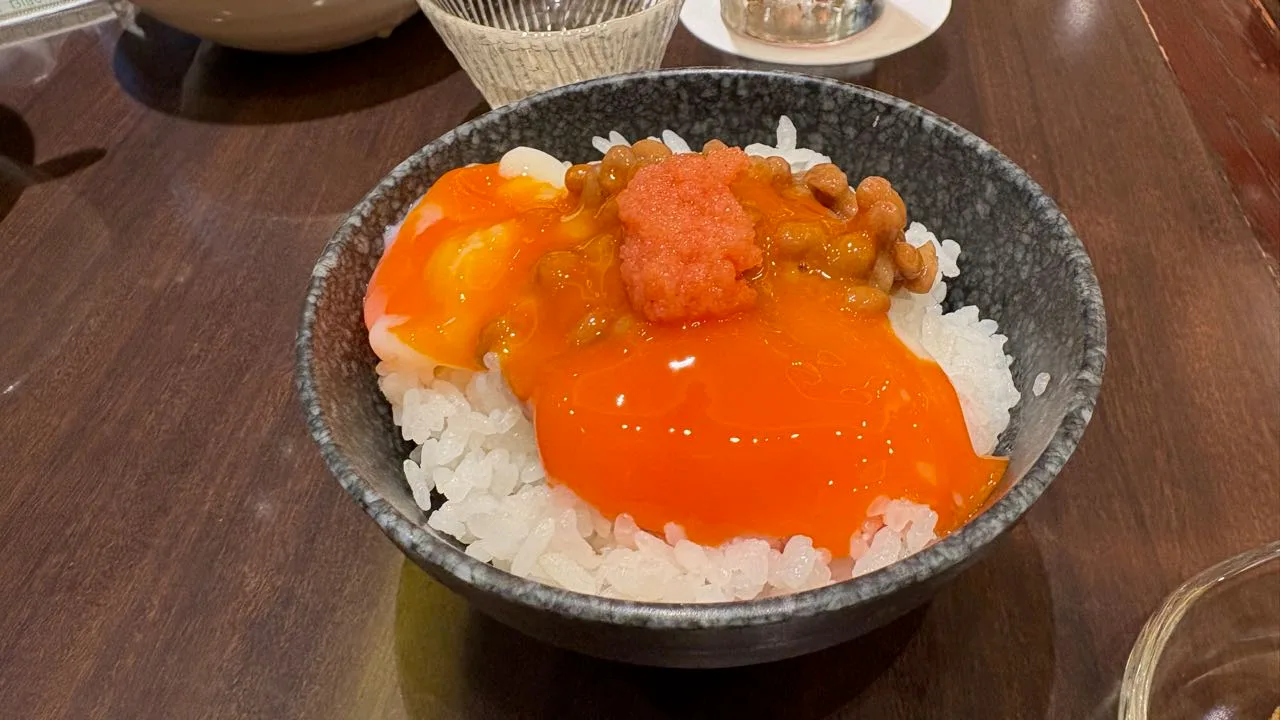
The finish is natto on rice, and this time one of us built the full version: natto on white rice, an onsen egg poured over with as little of the white as possible, karashi mentaiko on top, and a few drops of soy sauce on the yolk. Very good.
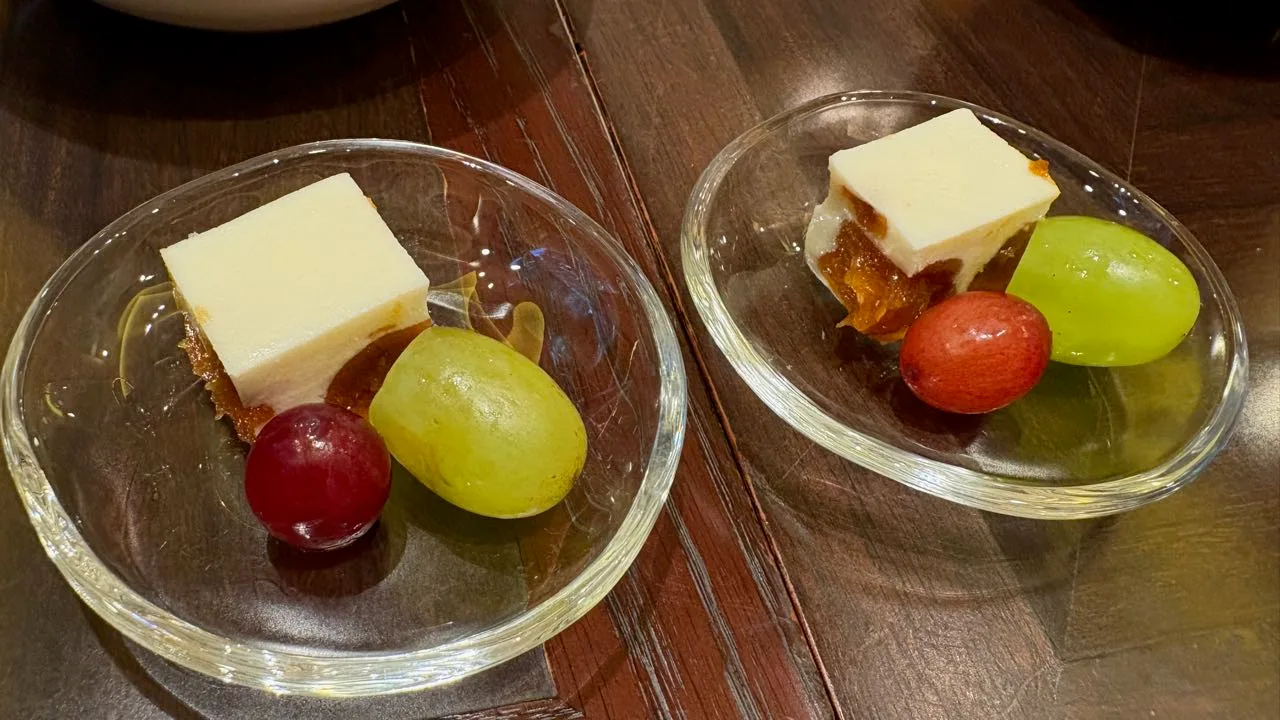
Partway through, a staff member brought the dessert that goes to Hilton Honors Gold and Diamond members: a terrine of anpo-gaki, soft dried persimmon, wrapped in something milky, with grapes. Sweet, and the grapes were properly sweet too. There were still dishes we had not reached, which made the next morning something to look forward to.
The evening: two senbero bars near Makishi market
After that came the room, then nearly an hour of walking in the hotel gym to work off the buffet, a bath, and out, hungry again anyway. The plan was to look in at a cat shop near the Daiichi Makishi Public Market (第一牧志公設市場), and nearby is something of a senbero heartland, so the two of us settled on senbero: ¥1,000 for a set of drinks, sometimes with food. The rules at these two and others are in our Naha senbero guide; this is the night itself.
Kawakami Sengyo No. 3: fast, cheap, cash only
Kawakami Sengyo No. 3 (かわかみ鮮魚3号店) had been full and lively every time we walked along Ukishima-dori, and always looked a little too local to walk into. This time we did. JAL OnTrip describes it as run directly by a fish shop.
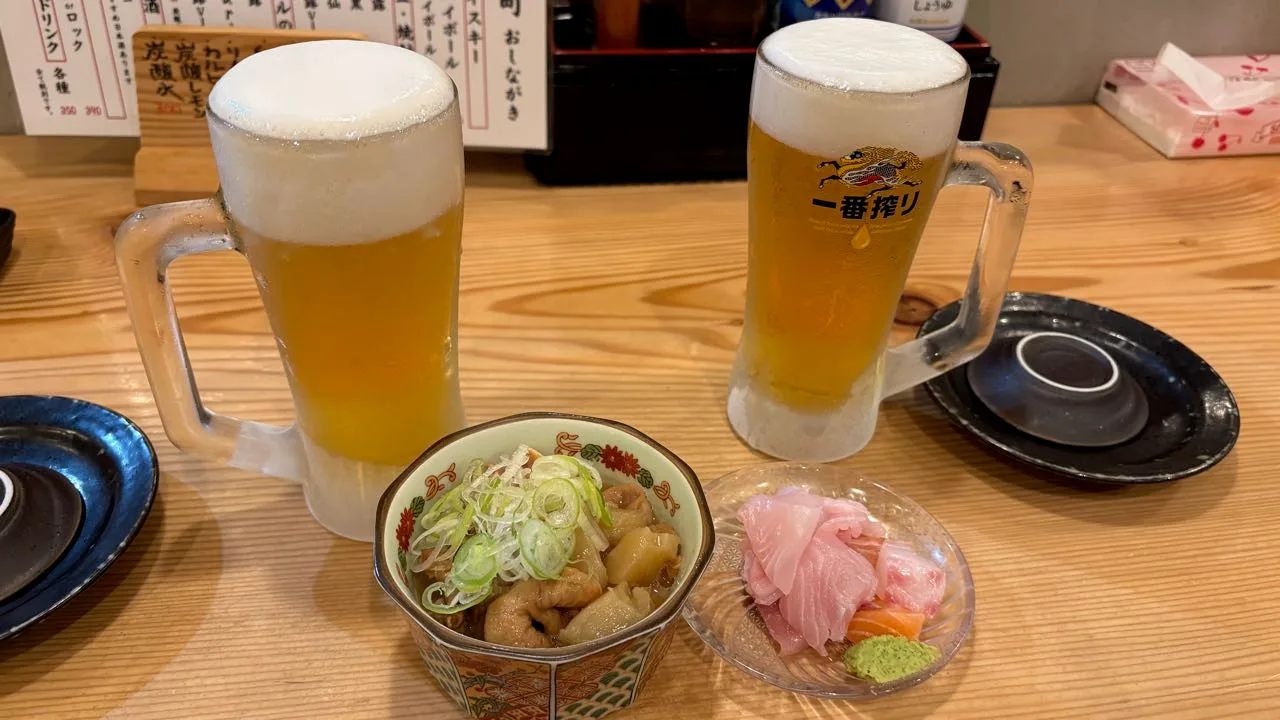
We ordered the sashimi set twice (sashimi, one dish from the handwritten daily list and three drinks, ¥1,000 including tax), guessing it was the best deal of the three. It came right after we confirmed, faster than Adachiya the day before: twelve slices a portion, all tuna as far as we could tell. Perfectly good tuna, but all tuna, so one set between us might do next time.
If you go: drinks are ordered by QR code on your phone too, which we learned by asking. In the senbero drinks section everything shows ¥0, and after you pick, the screen asks which senbero drink it is, first to fourth. Orion draft for both of us, straight away.
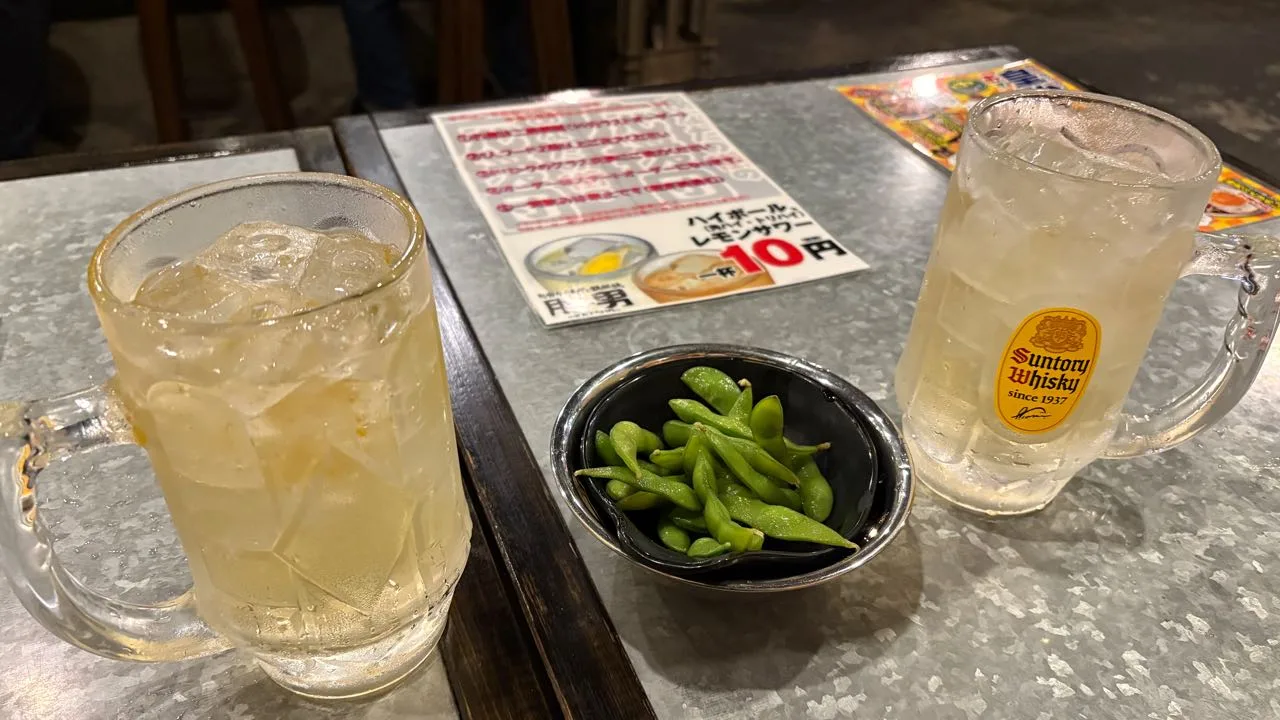
Round two: Kumejima no Kumesen awamori on the rocks for one of us, a highball for my wife, and ara-ni (maasu-ni), fish simmered in salt. Both came right away. The awamori came in a beer mug, a first, and one of us felt a little like a local, which was a happy feeling. It tasted like awamori; the mug takes nothing away.
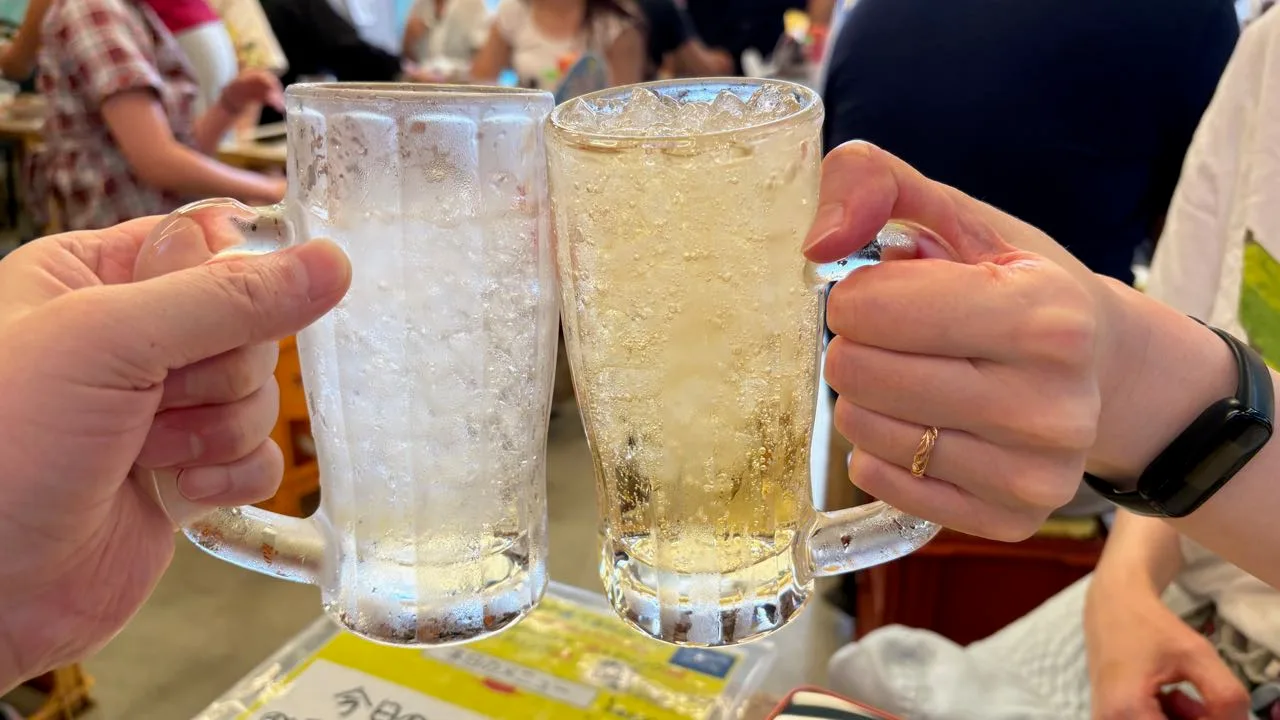
The highball was the weak spot. “Even people who don’t like highballs could drink this one,” said my wife. One of us tried it: thin, and a whisky taste he had never come across. The drink menu, we saw afterwards, heads its whisky section Koshu (甲州).
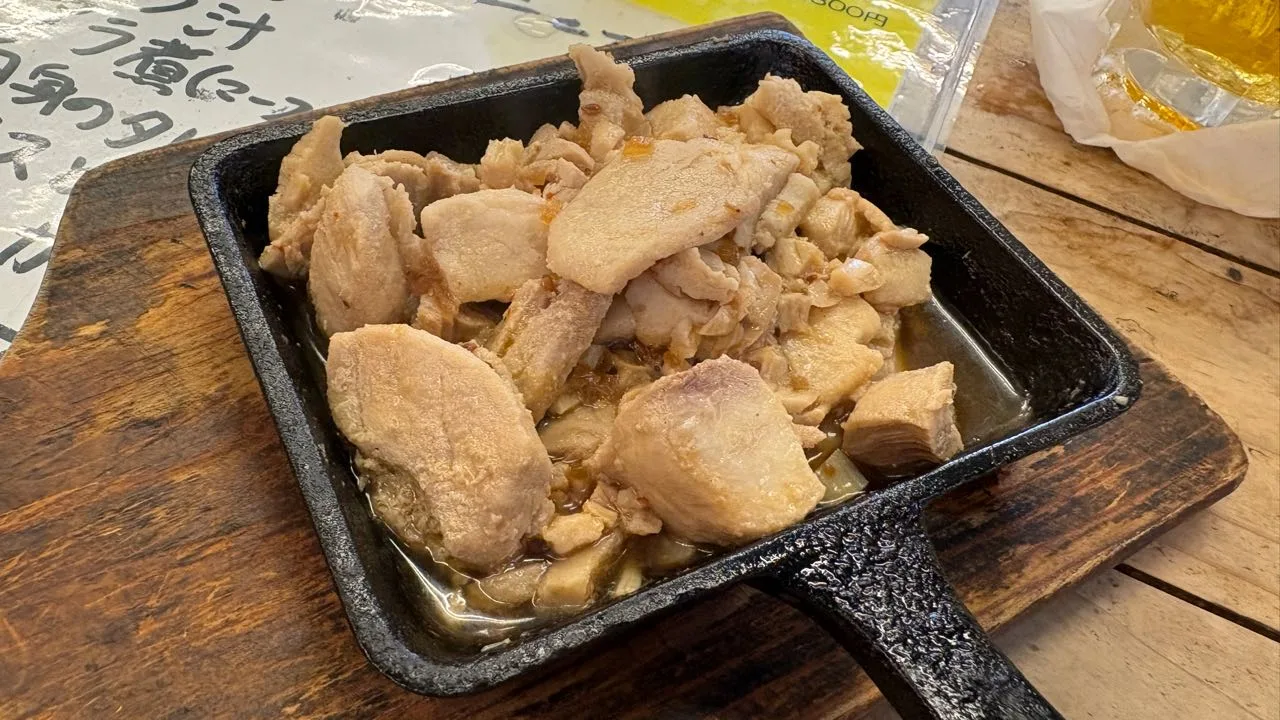
Last round, beer again for both of us, since it still felt like the best value, with shiromi no tare-yaki, white fish grilled in a sauce. It took a little longer, arriving sizzling on an iron plate: tuna again, perhaps, in something very like yakiniku sauce. Hot, and for one of us the best of the three dishes.
Cash only: ¥2,000 exactly for the two of us, about $13 at ¥150 to the dollar, the rate we use here. If it took cards, it would be perfect.
Taishu Kitchen Tamaya: glass counters and happy-hour beer
Taishu Kitchen Tamaya (大衆キッチンたまや) had caught our eye on an earlier visit to the area. It is a sister shop of Sauna no Tamayu (サウナの珠湯), upstairs in the same building.
The rules are on the menu cover: 60 minutes, QR self-ordering, and ¥1,000 for three ohajiki, glass counters, traded for drinks at one per star. Food is extra. Then the staff told us it was happy hour: on weekdays from 17:00 to 19:00, every beer costs one counter, two-star bottles included. Two sets, six counters.
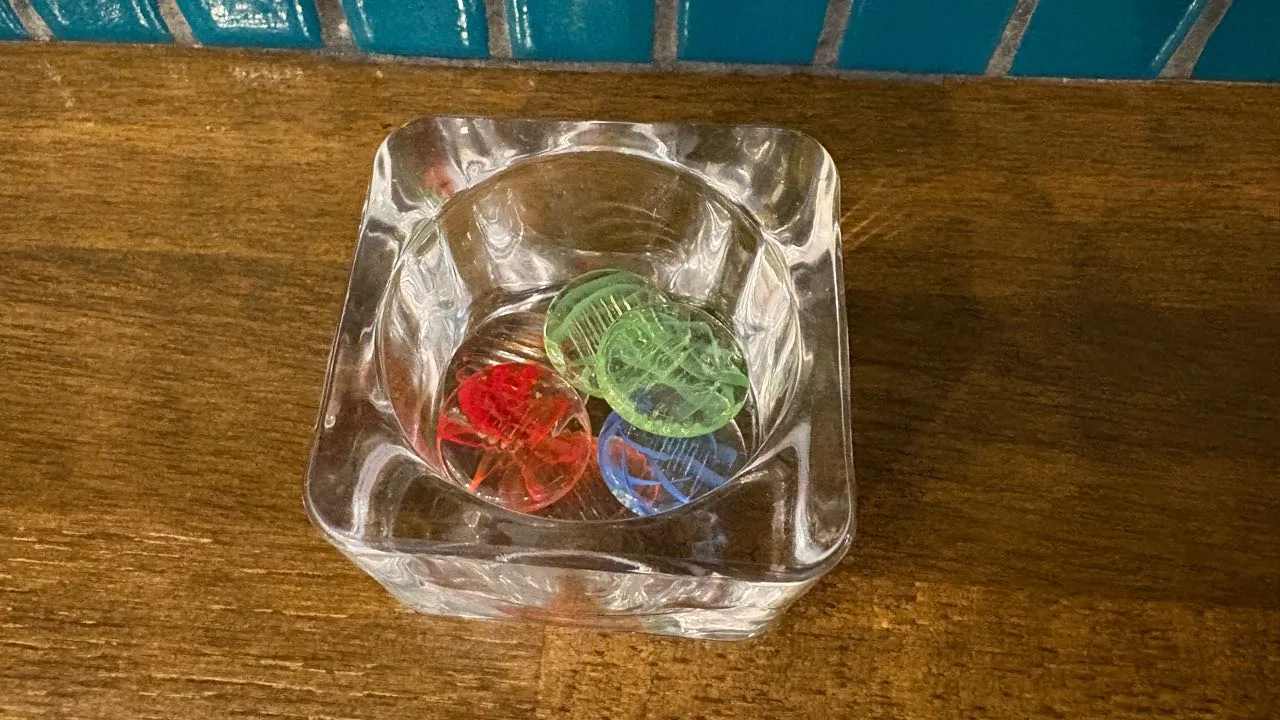
The value is in the two-star bottles, so that is where we started: a medium bottle of Sapporo Akaboshi, ¥600 on its own, for one counter, with two glasses. The dashimaki tamago, a rolled omelet, had plenty of dashi in it; “I love dashimaki,” said my wife. The second bottle was a medium Kirin Lager, the same deal.
With four counters left and the food running short, we added the Ryukyu Tamaya champuru, named for the shop, and the Uchinaa three-item plate: mimiga (pig’s ear) in a light sesame dressing, mozuku in vinegar, and umibudo, sea grapes, with ponzu. All cold, good for picking at. The champuru came hot, with both goya and fu, wheat gluten, plus egg, tofu and bean sprouts. Well seasoned. The sea grapes, our first of this trip, popped nicely.
Then our usual pair lately: awamori on the rocks for one of us, ender, picked because it is not one we see much elsewhere, and a highball for my wife. The awamori came in a proper glass, and the highball tasted like the highballs we know. The last two counters went on another Akaboshi and a final awamori, Masahiro. The room is clean and easy to walk into, and the music was songs we both knew; by then the two of us were humming along. ¥3,810 by card: two sets, dashimaki ¥600, champuru ¥700, three-item plate ¥510, tax included.
Sixty minutes seemed short to one of us at first. But if the third order only has to go in within the hour, half an hour over the last drink makes it 90 minutes, like the 90-minute limits elsewhere. That is our reading of it.
What it cost
| Where | What | Paid |
|---|---|---|
| Kawakami Sengyo No. 3 | sashimi senbero set × 2 | ¥2,000, cash |
| Taishu Kitchen Tamaya | senbero × 2, three dishes | ¥3,810, card |
| The evening, for two | ¥5,810 (about $39) |
Prices on 20 October 2026, tax included.
Would we do it again
The breakfast, yes: it is the meal we look forward to here, and the dooru-ten is a certain repeat.
Kawakami Sengyo No. 3, if we are passing: fast, cheap, and the first place to hand us awamori in a beer mug. Tamaya, if we are passing too: a clean room, happy-hour beer at one counter, a good champuru.
Two senbero stops, properly berobero (drunk), for ¥5,810.
Practical bits
- Hotel: DoubleTree by Hilton Naha, no executive lounge. Breakfast hours, and the price if you pay for it separately: we didn’t check.
- Breakfast: staff took our drink order at the table. The dish cards in our photos carry English, Chinese and Korean under the Japanese (“Okinawa Soba”, “spicy cod roe”). The dessert is a Hilton Honors Gold and Diamond perk.
- Kawakami Sengyo No. 3: Matsuo 2-10-20 on our receipt, about 90 m from the Daiichi Makishi Public Market per JAL OnTrip. Cash only, 90 minutes at the table, QR ordering. Per Tabelog, 14:00 to 22:15 (JAL OnTrip says from 14:30), closed Mondays, non-smoking, no reservations (checked October 2026).
- Taishu Kitchen Tamaya: Makishi Chuo Market Building 1F, Matsuo 2-11-1. Card accepted. 60 minutes per ¥1,000 set; a second set is allowed. Weekday happy hour 17:00 to 19:00 (the staff told us on our visit). Per Tabelog and JAL OnTrip, weekdays 17:00 to 24:00, heated tobacco only in a separate area, and reservations taken (checked October 2026).
- English menus at the bars: the printed menus we photographed at both were essentially Japanese-only. QR screens: we didn’t check.
- Walking time from the hotel, and how many tourists: we didn’t check.
Facts checked 2026-10-29. Prices, hours and menus are what we saw on our visit; they change. Nothing here was sponsored or comped.