Hilton Fukuoka Sea Hawk Executive Lounge, night five: mizutaki, gameni and the ¥1,760 rock bath
This article contains affiliate links to hotel booking sites; if you book through one we may earn a small commission at no cost to you. How that works.
Day five of five at the Hilton Fukuoka Sea Hawk, August 2026, and the last cocktail time of the stay was the Hakata one: gameni, pork kakuni, mizutaki and Goto udon in the same evening. Five nights in the Executive Lounge, and the hot dishes never repeated.
We hold Hilton Diamond, which is how we are in the lounge at all. The rest of the stay: night one and the suite, breakfast, the gym and the Western night, night three, the lounge’s move.
Breakfast, day five: the Belgian waffle comes round again
Our fourth breakfast in the lounge, and the first thing we do is read the card for Today’s Plate, the dish that changes every morning and comes to your table.
Today’s Plate Belgian waffle Fruits Compote and Whipped Cream
Exactly what the second morning produced. Twice in four breakfasts, so if Today’s Plate runs on a rotation, it may be a rotation of only three. One more morning would tell us, and we had one more morning coming. We ordered it anyway.
The rest is the usual raid: salad first, with smoked salmon on it for the first time and four okra on my wife’s plate; then mentaiko, takana and ume-hijiki for the rice, the mentaiko on the grilled salmon — her idea from the morning before, now on its second day.
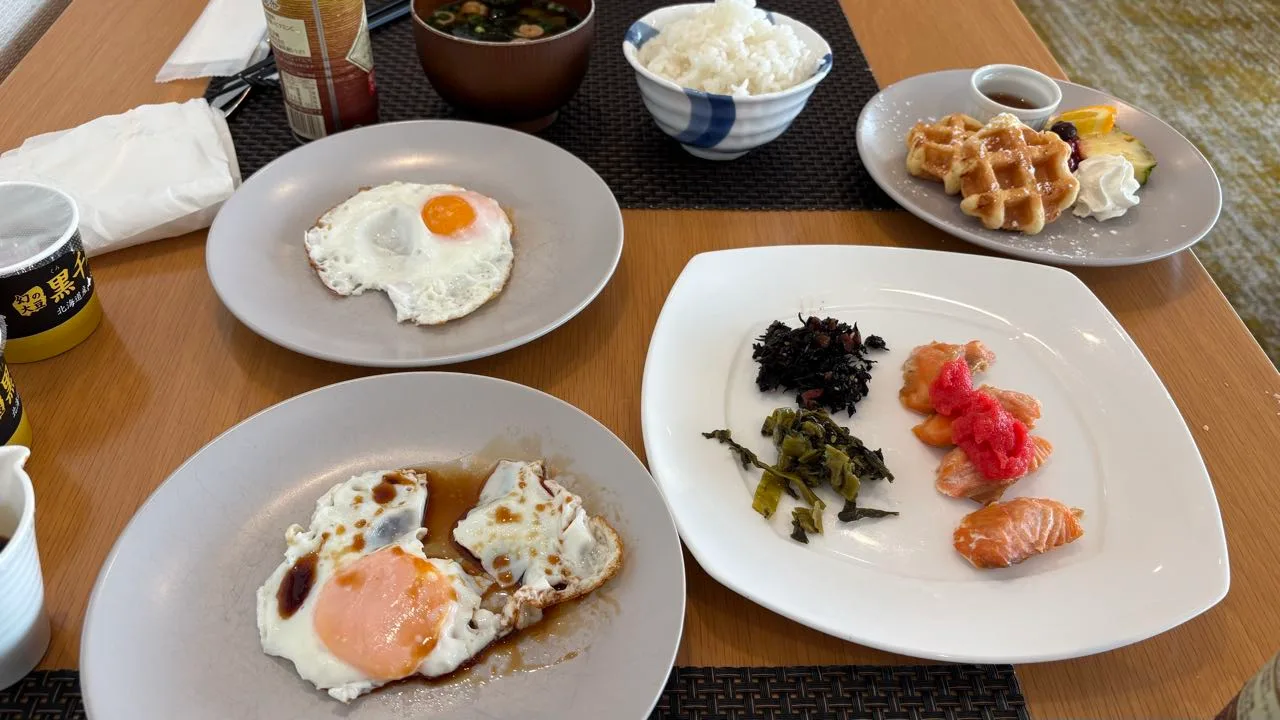
“Natto and fried egg on rice really is good,” said my wife, and it is. The black-soybean natto, Kurosengoku, has a tare on the sweet side; the soy sauce on the fried egg is salty; the two meet in the middle. Fruit and waffle at the end — the fruit here is genuinely fresh, the pineapple especially sweet.
Tomorrow is the departure day, so we agreed to go easy at breakfast — and then had to decide easy on what. The salad is the healthy one; the natto rice is the good one. The natto rice stays.
The rock bath, “Iwaburo” on the sign: ¥1,760, ¥0 for us
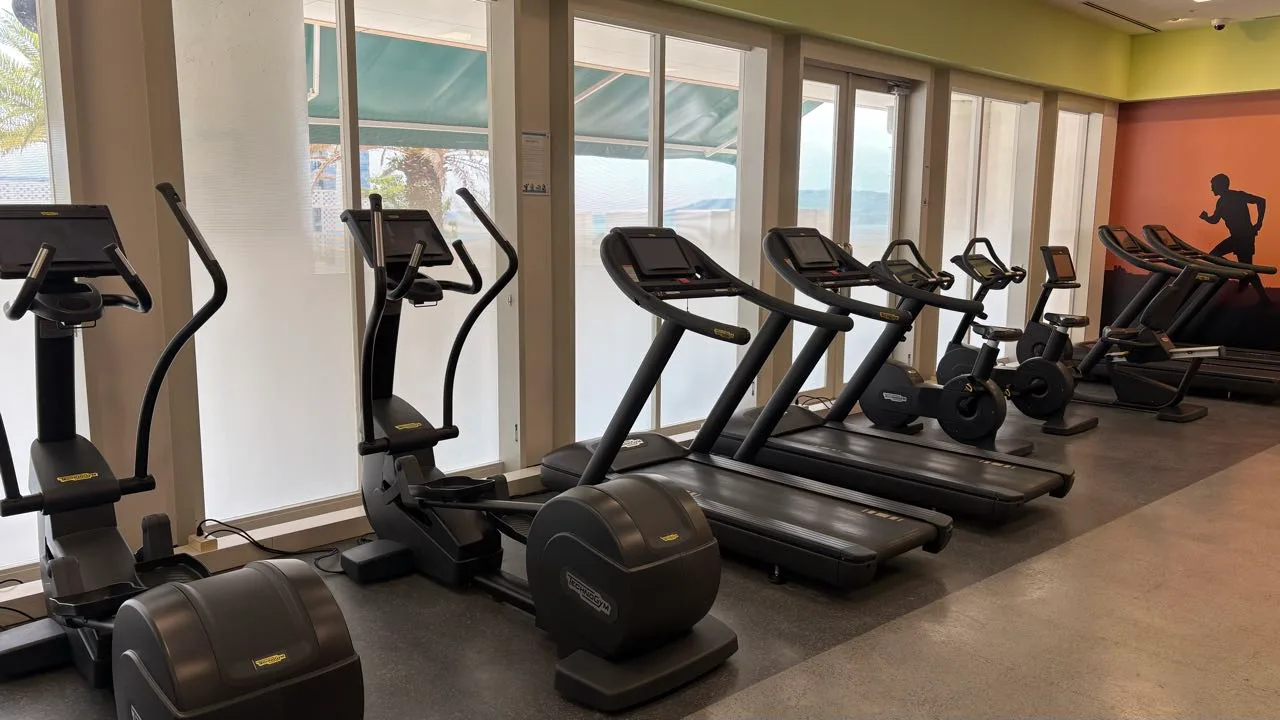
We went down to the gym again, on the fifth floor. Running or walking every day had caught up with us, so this was a walking day: about fifty minutes.
Then the rock bath — the sign’s English calls it the Hot Stone Bath — free for us all stay after we asked at check-in on the first day. But the notice at the entrance prices it plainly, and if you are not getting it thrown in, this is the number.
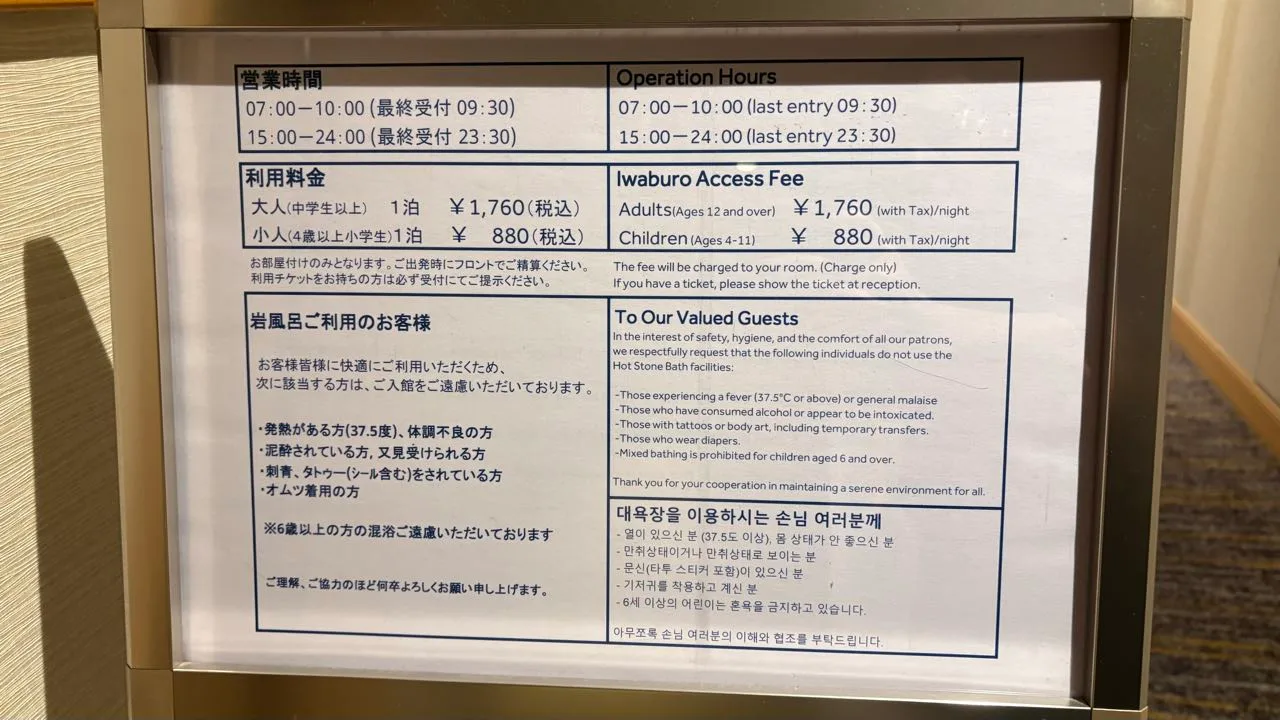
Hours are 07:00–10:00, last entry 09:30, and 15:00–24:00, last entry 23:30. The fee, as of our August 2026 stay: adults aged 12 and over ¥1,760 a night including tax, children aged 4 to 11 ¥880. At ¥150 to the dollar, the rate we use here, that is about $12 a night for an adult. It goes on your room — charge only — and you show a ticket at reception if you have one.
The same notice, in English as well as Japanese, asks several groups not to use the bath: anyone with a fever of 37.5°C or above, anyone who has been drinking or appears intoxicated, anyone with tattoos or body art including temporary transfers, and anyone in diapers. Mixed bathing is not allowed from age six. If tattoos were your question for the front desk, the sign answers it first.
Night five is Hakata
We walk the whole counter before anything goes on a plate. Four dishes that evening, all of them from Hakata and Kyushu, with the English below off the cards rather than ours:
- Hakata gameni (博多がめ煮) — “Simmered chicken and vegetables in soy”, with lotus root and carrot in big pieces
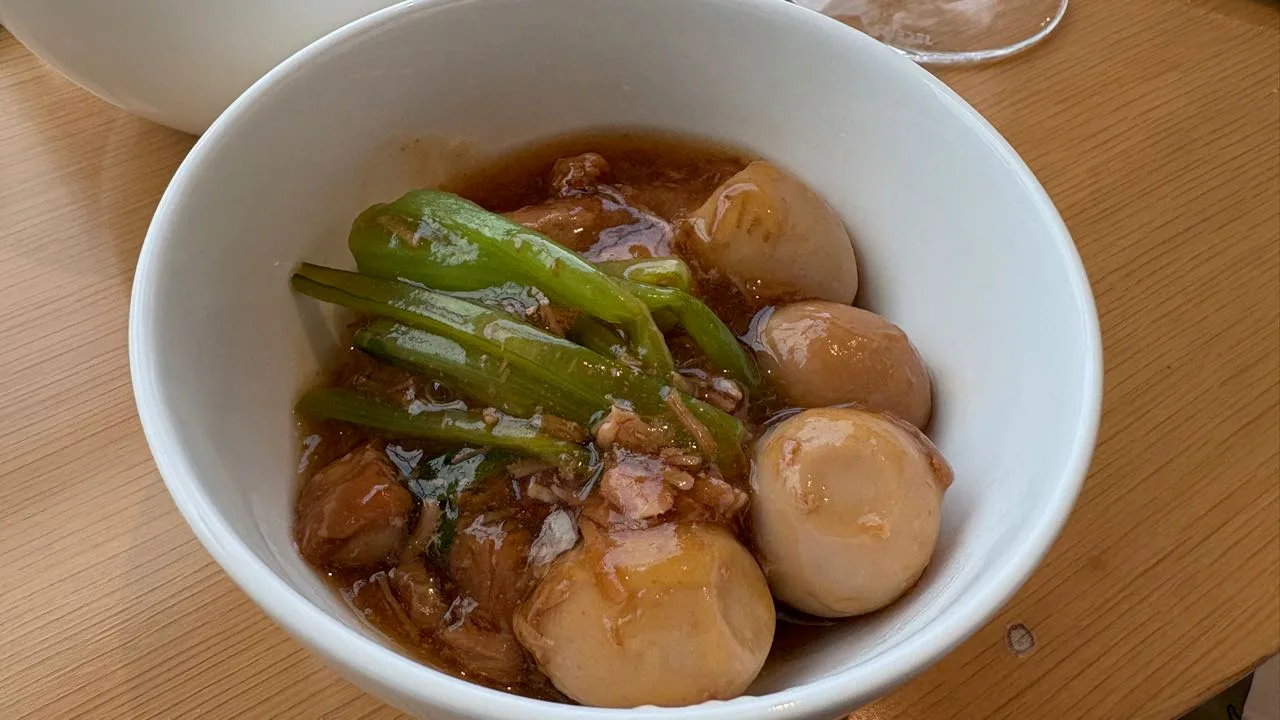
- Simmered pork with sweet soy (豚角煮) — kakuni, with quail eggs dotted through the broth
- Mizutaki (水炊き) — “Hot pot with chicken and vegetables in chicken soup”, in a blue casserole on a hotplate
- Goto Udon with Nankan-age (五島うどん南関あげ) — “Hand-stretched thin noodles with premium fried tofu”
Three of them hot. The udon is the exception: cold, portioned into small red lacquer bowls with green onion and nankan-age on top, and you pour the broth from the pitcher beside the stack.
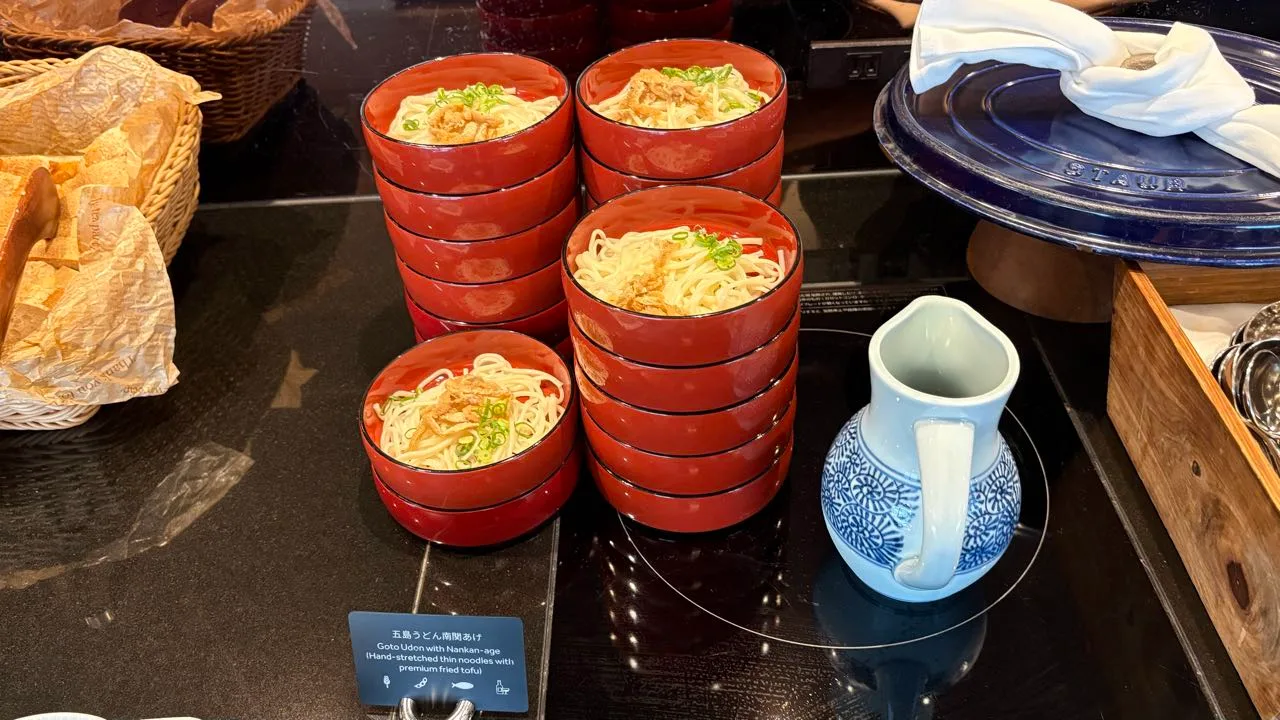
On an earlier stay this lounge ran an evening called 博多のゆうべ, a Hakata night, with motsu-nikomi and mizutaki — the sort of lineup that exists to be drunk with. We had been wondering whether it would come round again, and this was close enough that both of us stood there grinning. Motsu-nikomi and Oita karaage should make a comeback one day, we said.
And the fact that carried the whole five nights: the menu was different every single day.
Corona, and a mizutaki with no chicken in it
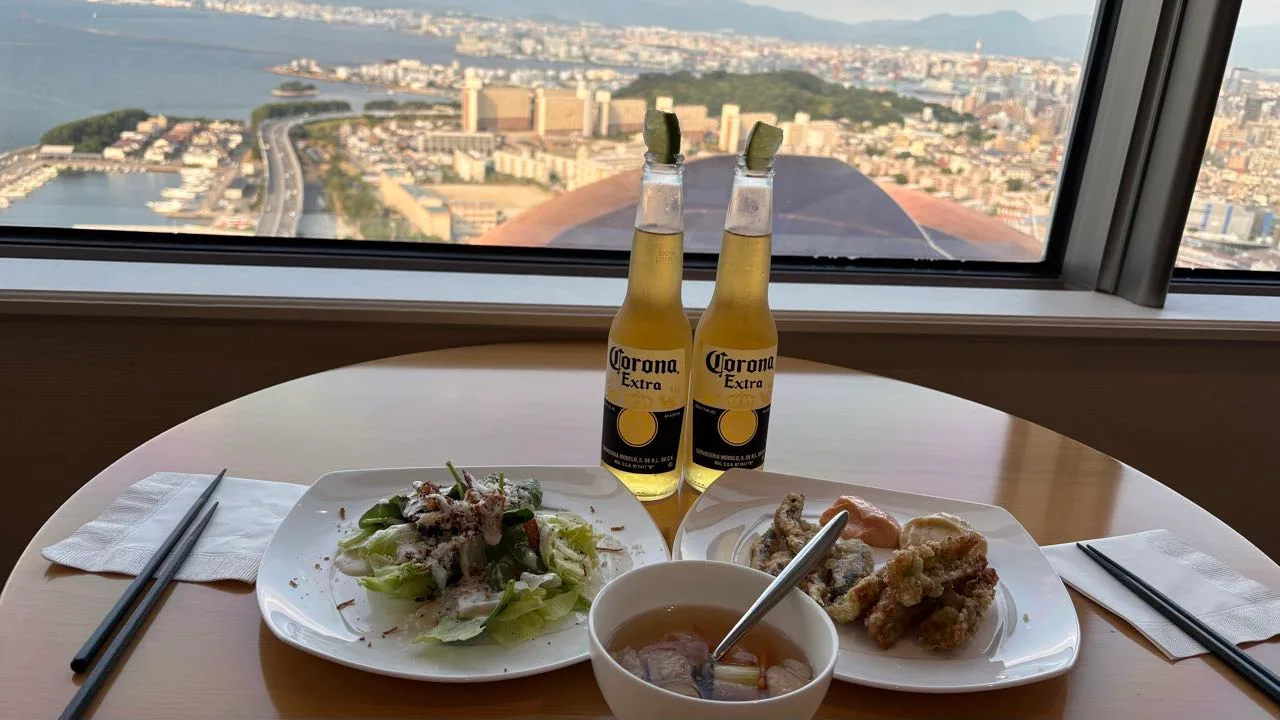
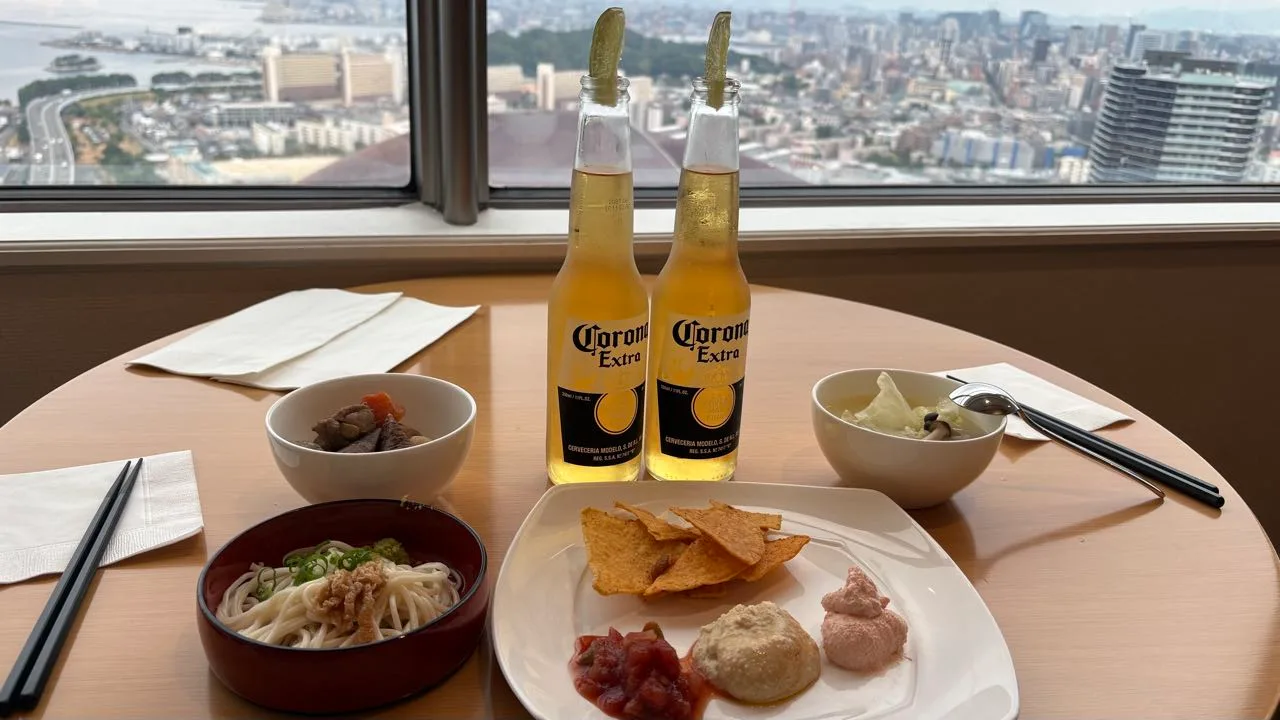
First plate: tortilla chips with the three dips, the Goto udon, the mizutaki and the gameni. To drink, a Corona with the lime squeezed in, straight from the bottle.
The gameni is seasoned lightly for something simmered in soy, and it gets vegetables into you while you drink. “This could be a good snack for tonight,” my wife said. The Goto udon got the verdict from across the table: “Good bite on these noodles.” A little thicker than somen, closer to hiyamugi, and they go down easily.
The three dips are chunky salsa, bean hummus and mentaiko sour cream. The mentaiko landed with one of us and not the other — cod roe in sour cream, cold and salty, enough on its own to drink on.
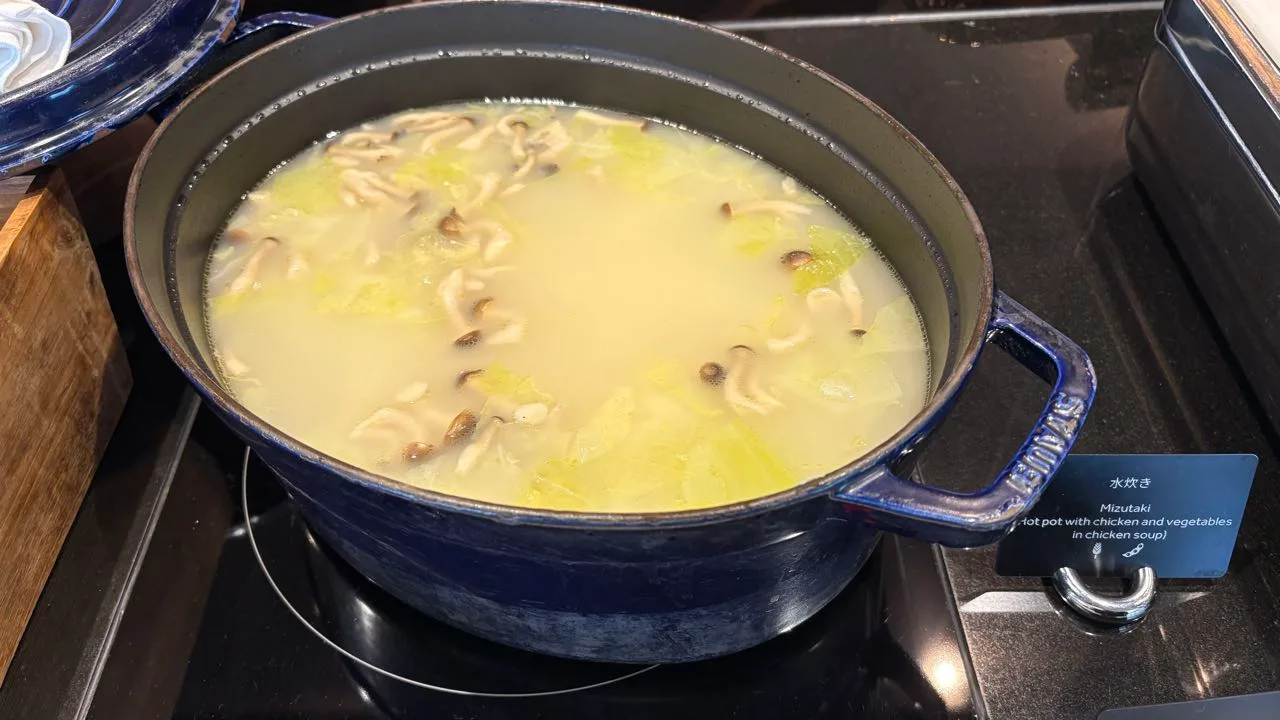
Then the mizutaki, which my wife ladled out and brought over, and which arrived with no chicken in it at all.
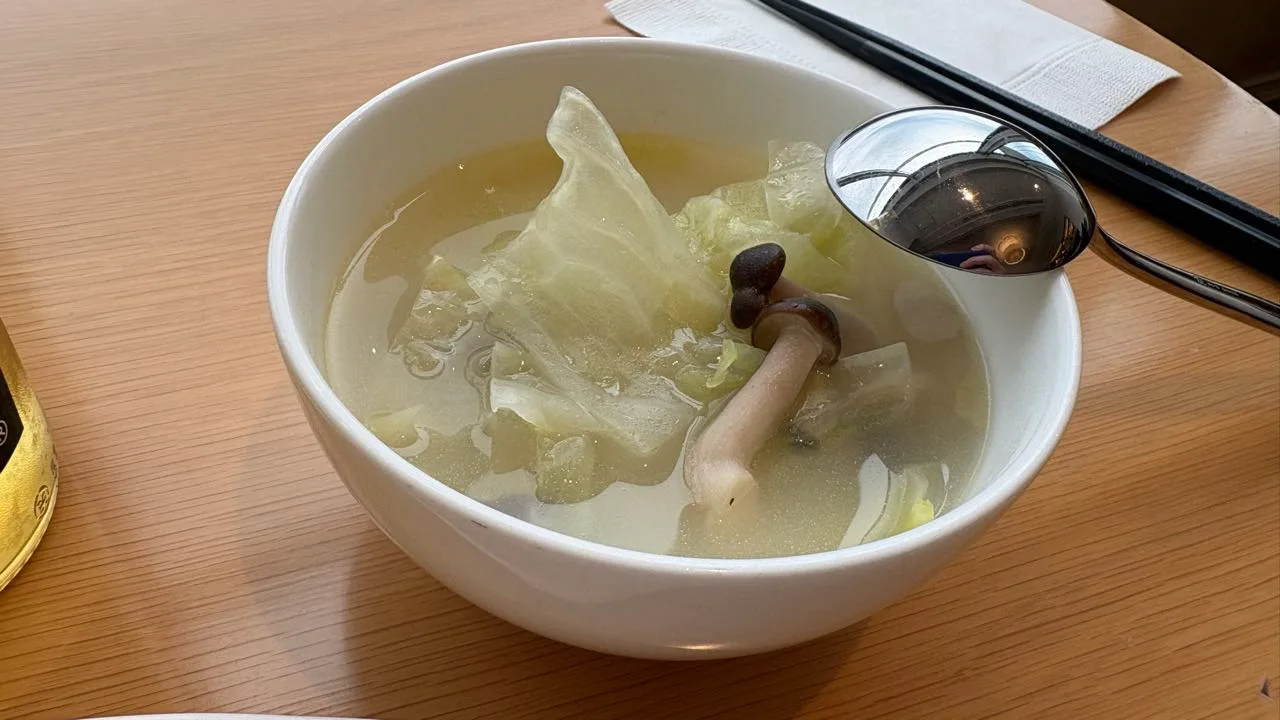
Either it had gone five minutes into service, or there had never been any. The soup itself is properly chicken — not as concentrated as the one we remember from the Hakata night, but good, and my wife kept saying so.
The chicken was at the bottom of the pot
Beer finished, second lap, and we went back to settle it. Drag the ladle along the bottom of the pot and there it is: chicken, under everything else.
Back at the table the theory was offered that the ladle does not reach the bottom easily. “Mm, no,” said my wife, with a sad face, and she is probably right: even hunting for it, only a few pieces came up. There may well have been none when she went the first time.
The first bowl had gone down plain, to taste the soup. The second came back with ponzu and yuzu kosho.
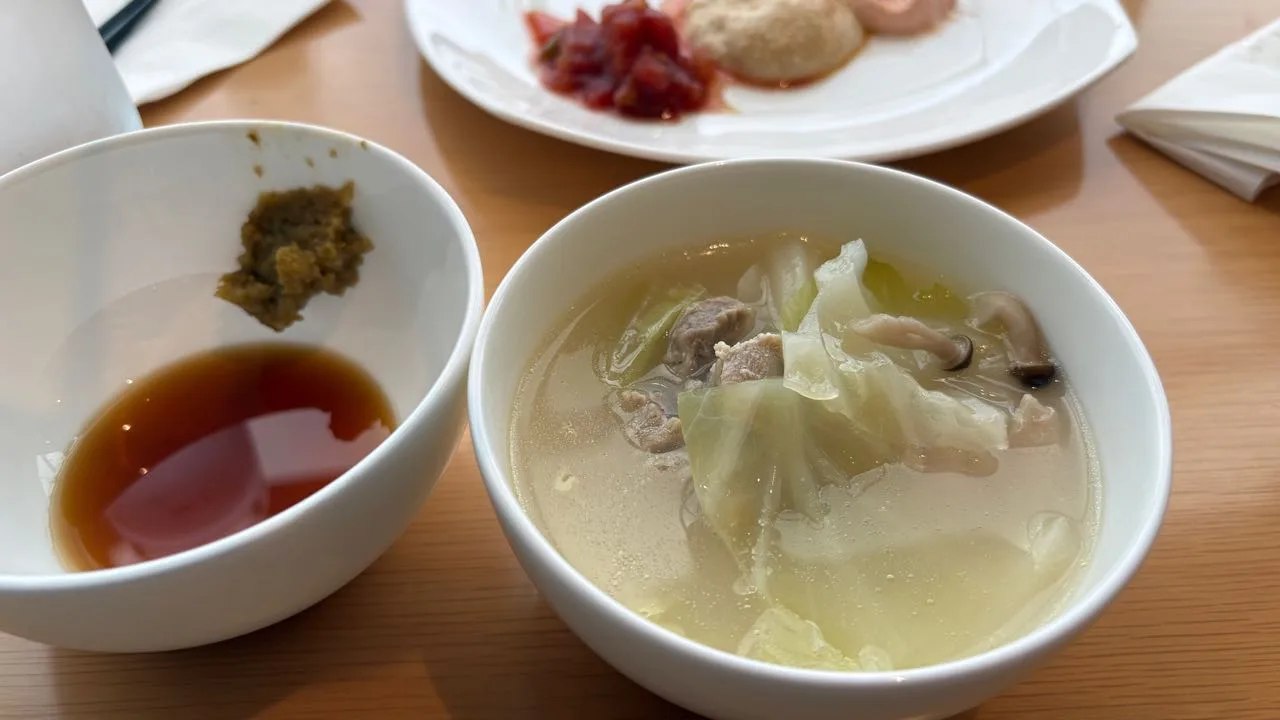
Chicken with a smear of yuzu kosho is very salty and very good; the ponzu is the gentle version. “You could drink several glasses on this yuzu kosho alone.” “It is a yuzu-kosho-drinking sort of thing.” From here on, white wine.
Kakuni, Chianti, and the staff member who came back
Next, a glass of red each — Terre de’Priori Chianti, from Tuscany — and the one dish we had not touched yet, the kakuni. It comes with quail eggs in the broth, which is its own small event. We took four.
We had barely sat down when the staff member who had been kind about it the evening before came over. “You may have been told an hour again today, but it is quiet, so please take your time.”
We must have looked crushed when the one-hour line came out the day before, and someone had presumably passed it on. We ate the pork feeling a little exposed.
My wife ate a quail egg with the face of someone very pleased to be eating one. Both of us like eggs; a boiled egg is close to perfect. The kakuni is good, and it belongs with the red.
Which produced the line of the stay: on the last night, this might be the best food we have had here. My wife nodded — today is the best of them.
The fifth night, and an appetite that never turned up
After the red we went back to white, with more mizutaki and gameni and the kakuni bowl still on the table.
Half of the two-hour cocktail time had gone and one of us was already comfortably full, which is what happens when the meat dishes are this good. The odd part was that the hunger had not been there to start with. “I am not that hungry today from the beginning — did we overdo breakfast?” my wife said. “Or is it five days adding up?” Usually the bath makes us hungry, and today it did not.
No conclusion was reached, and it changed nothing: the lounge was quiet, and the last evening ended full.
Would we do this again
Yes, and the reason is the rotation rather than any single dish. Five nights, five sets of four dishes, and no evening repeated another. That keeps the lounge worth going to on night five, instead of a counter you are bored of by midweek.
That the best evening was the last is luck. But the Hakata set is the one you get here because it is Fukuoka — gameni, kakuni, mizutaki and Goto udon in one sitting, at ¥0 with lounge access. Day five inside the building: breakfast ¥0, cocktail time ¥0, nothing extra for the gym or the rock bath, no wallet.
One caveat: the lounge moves to the fifth floor on 1 October 2026. The room we sat in will not be the room you sit in, and whether the rotation carries over we will not know until we go back.
Practical bits
- Cocktail time: two hours, opening at 17:00 on our August 2026 stay. Food and drink ¥0 with Executive Lounge access; we get in on Hilton Diamond status.
- The rotation: four dishes on the counter, changed every evening, nothing repeated across five nights. Night five was the Hakata set: gameni, simmered pork with sweet soy, mizutaki, Goto udon with nankan-age.
- Mizutaki, if it is on: the chicken sits at the bottom of the pot, under the cabbage and mushrooms. Take the ladle down before you decide there is none. Ponzu and yuzu kosho are on the counter beside it.
- Food cards: Japanese with English underneath — “Hot pot with chicken and vegetables in chicken soup” is the card’s wording, not our translation.
- Breakfast: Today’s Plate changes daily and comes to your table; the Belgian waffle came round twice in four breakfasts. One portion between two was plenty.
- The rock bath: hours and fee as above, charged to your room only. Free for us, confirmed at the desk on arrival — ask at check-in rather than assuming. Tattoos, including temporary ones, are on the notice’s exclusion list. The gym cost nothing extra either.
- Reservations, cards and smoking in the lounge: we didn’t check.
Facts checked 2026-09-06. Prices, hours and menus are what we saw on our visit; they change. Nothing here was sponsored or comped.